
"Glass self-explosion" is alarming; "rooms feel like saunas in summer"; "heating escapes entirely in winter"; "outdoor noise causes insomnia"... Are you also troubled by these pain points of traditional door and window glass? Ebon Tongtai High-Performance Thermal Insulation Doors & Windows offers the solution: 3i-Low-E Glass — not only an "anti-self-explosion expert" but also an all-rounder integrating "thermal insulation, heat preservation, sound insulation, and safety", redefining the "glass standard" for high-performance thermal insulation doors and windows.
01. Anti-Self-Explosion: Just the Basic Standard
The self-explosion rate of ordinary glass is about 3‰, like an "unpredictable time bomb" — it may be triggered by vibrations during decoration, uneven heating due to extreme high temperatures, or even "sudden cracking" for no reason. Deeply aware of the profound impact of glass self-explosion on consumers, Ebon Tongtai 3i-Low-E Glass has become the first brand in the industry to reduce the glass self-explosion rate to 0.1‰ through R&D innovation, solving the industry pain point of glass self-explosion at the source of doors and windows.
Relying on a strong glass deep-processing industrial chain, Ebon Tongtai Doors & Windows selects high-quality Xinyi ultra-white glass substrates with minimal impurities and high purity. Meanwhile, the glass undergoes 4-hour homogenization heat treatment (HST) at a constant temperature of 290℃, allowing potential impurities to release stress in advance and eliminating internal "invisible cracks". Before leaving the factory, each glass panel undergoes an explosion test in a glass self-explosion test kettle, enabling nickel sulfide particles in the tempered glass to complete phase transformation during homogenization. This ensures the self-explosion rate of tempered glass is below 0.1‰ before delivery, fundamentally eliminating the causes of glass self-explosion. It is a tribute to safety and a brand's sense of responsibility.

02. Ebon Tongtai 3i-Low-E Glass: More Practical Black Technology Beyond Anti-Self-Explosion
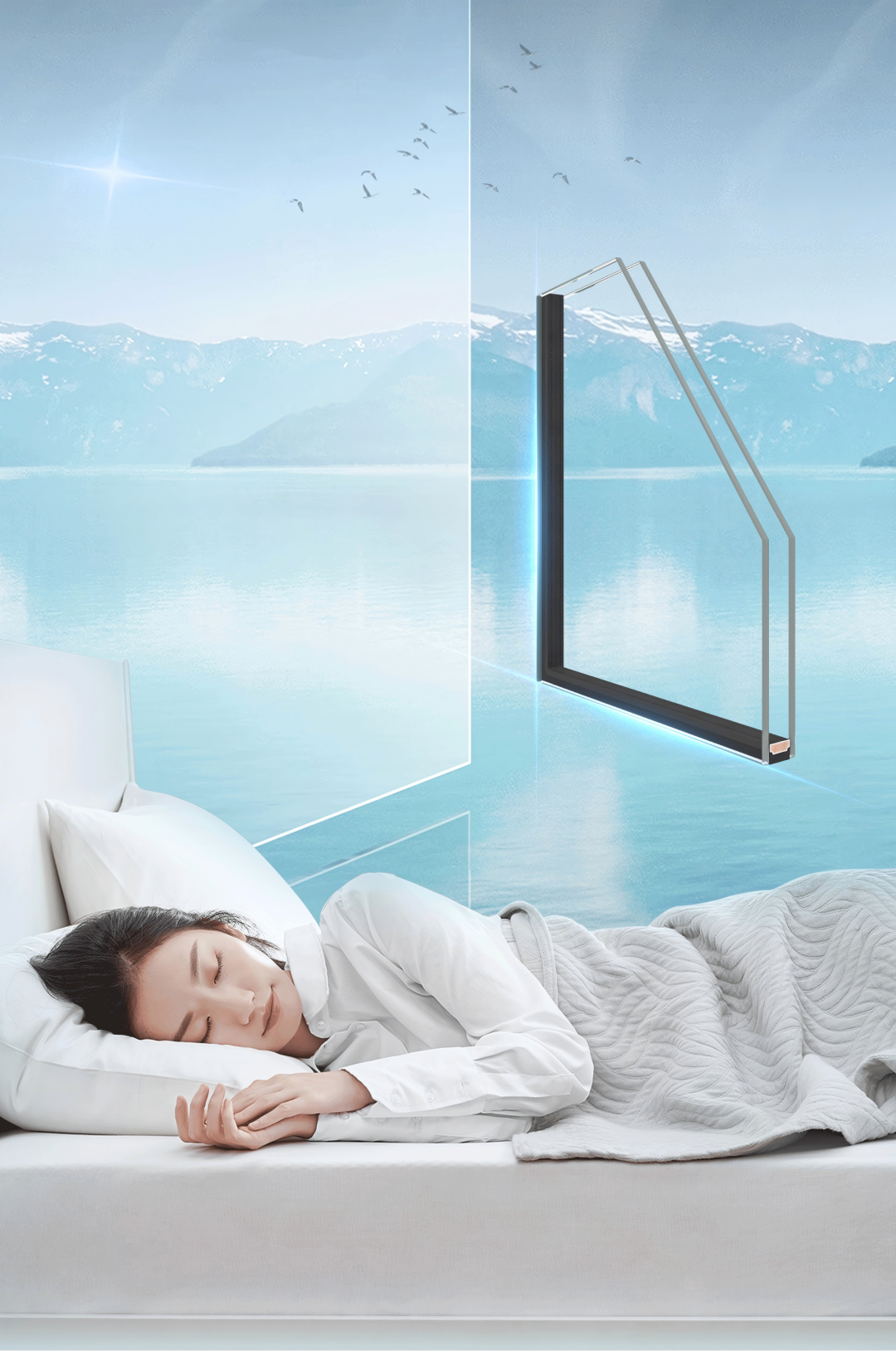
If anti-self-explosion is the "safety bottom line", the true strength of 3i-Low-E Glass lies in its black technology combination of "Low-E coating + insulated glass structure + inert gas", addressing high-end users' ultimate needs for doors and windows — "no stuffiness in summer, no cold in winter, and a quieter home".
Ordinary glass allows over 80% of infrared rays (heat sources in sunlight) and ultraviolet rays (the main culprit harming the skin) to penetrate directly into the room. The "Low-E coating" of 3i-Low-E Glass acts like an "intelligent filter": it blocks over 97% of solar ultraviolet rays and 95% of infrared rays while allowing visible light (natural lighting) to pass through. Even under direct noon sunlight in summer, the indoor temperature with 3i-Low-E insulated glass is 10℃ lower than that with ordinary single glass, the overall window thermal insulation performance is improved by over 60%, and air conditioning energy consumption is reduced by 30%-40%.
What's the pain point in northern winters? Even with heating on, the area around windows remains chilly, and condensation even forms on the inner side of glass! The insulated layer (usually 12-20mm) of 3i-Low-E Glass is filled with 94% high-purity argon (with a thermal conductivity only 1/3 of ordinary air). Combined with the "heat reflection" function of 3i-Low-E Glass, it forms a "double-layer protection": the argon buffer layer slows down heat exchange between indoor and outdoor, preventing windows from becoming "heat loss loopholes"; the Low-E coating locks in indoor heat, avoiding heat loss through glass. Even in northern winters, the heat preservation performance of 3i-Low-E Glass is more than 3 times that of ordinary double-layer glass, the probability of window condensation is reduced by 90%, the indoor temperature is more uniform, and the elderly and children no longer feel cold when approaching windows.
Homeowners living near streets or elevated roads know how poor the sound insulation effect of ordinary windows is — car horns and construction noise can be annoying at any time. The structure of 3i-Low-E Glass — "insulated glass combination + 94% argon + multi-channel sealing strips" — builds a powerful "sound insulation barrier": the insulated layer filled with over 94% argon effectively blocks medium and high-frequency noise (such as human voices and traffic noise); the multi-cavity structure design, combined with high-quality sealing strips, blocks low-frequency noise (such as engine roars) layer by layer. After closing the windows, both urban hustle and daily noise are gently blocked outside. Babies can sleep peacefully, and working from home is no longer disturbed by noise.
What is the standard for a good door or window? It is not simply "anti-self-explosion", but the ability to solve five major pain points simultaneously: "safety, thermal insulation, heat preservation, sound insulation, and lighting". Ebon Tongtai High-Performance Thermal Insulation Doors & Windows, with the multiple protection of "3i-Low-E Glass + 94% argon in insulated layer + sealed strip structure", redefines the benchmark for high-performance thermal insulation doors and windows. This autumn, upgrade to Ebon Tongtai Doors & Windows equipped with 3i-Low-E Glass as standard — use less air conditioning in high temperatures, less heating in cold winters, enjoy a quieter home, and live a more worry-free life.
 EN
EN